
What Is a Meyhane? Table, Rakı and Conversation in Brief

Updated: 3 days ago
A meyhane is a traditional place where rakı or wine is enjoyed with mezes and seasonal fish at a shared table. If you are planning your first visit, the your first meyhane guide covers the practical steps. This guide was written by Koço Restaurant, a meyhane across from Moda Pier.
Short answer: A meyhane is a place where drinks are enjoyed slowly, together with mezes, fish and conversation. It differs from a lokanta because drink and conversation sit at the centre, and from a bar because food does.
What Does Meyhane Mean, and Where Does the Word Come From?
The word meyhane comes from the Persian words "mey" and "hane" and roughly means "house of wine". In Persian, mey means wine and hane means house. The same "hane" appears in other Turkish words such as kahvehane (coffee house) and kütüphane (library).
The Turkish Language Association's Current Turkish Dictionary defines a meyhane as a place of entertainment where drinks are sold and enjoyed. The person who runs a meyhane is called a meyhaneci.
In today's usage, meyhane describes a table culture broader than the dictionary definition. In everyday speech, the word also names the evening table built around rakı and mezes. Mezes, fish and a long conversation share the table. Plates are set in the middle of the table, and everyone shares.
What Do You Find on a Meyhane Table?
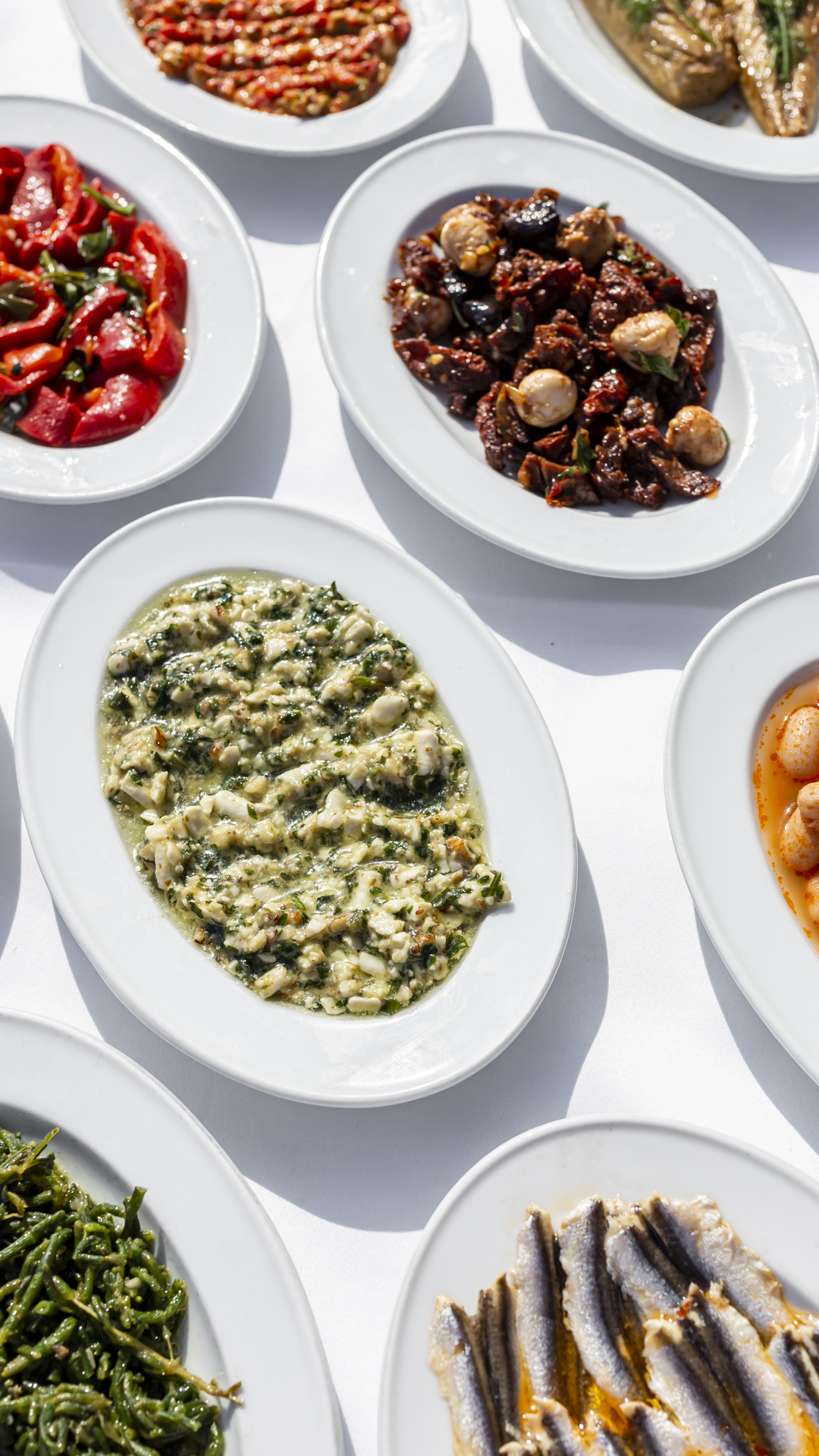
A meyhane table usually holds cold and hot mezes, seasonal fish and rakı. The core parts of the table are:
Cold mezes: Olive-oil dishes, spreads, salads, white cheese and melon usually make up the first round.
Hot mezes: Also called ara sıcak, dishes such as calamari, börek or liver arrive after the cold ones.
Fish: Seasonal fish is often the main dish of the table, and it usually comes grilled or pan-fried.
Rakı: An aniseed spirit; it is the best-known drink of the meyhane table.
Other drinks: Wine, beer and soft drinks are also common at a meyhane table.
Conversation: The real heart of the table, and it sets the pace of the evening.
For the variety of mezes, see the essential meyhane mezes guide. For choosing fish by season, the seasonal fish guide shows the way.
How Does a Meyhane Evening Go?
A meyhane evening usually starts with cold mezes and moves slowly over several hours. Hot mezes arrive as the conversation deepens. Seasonal fish is often added after them.
Dessert or fruit usually comes at the end; tea or Turkish coffee may close the table. You do not need a special occasion to go to a meyhane; a meyhane evening is often simply a reason to meet and talk.
At a meyhane table, plates go to the middle of the table, not to each person. Orders are placed little by little, not all at once. This way the table is refreshed through the evening, and nobody hurries.
The rhythm is the same at a crowded table and at a table for two.
What Is the Difference Between a Meyhane, a Lokanta, a Restaurant and a Bar?
What sets a meyhane apart from other places to eat and drink is that drink, food and conversation carry equal weight. A short comparison of the four types:
Lokanta: Usually serves ready-cooked or home-style dishes; there is often no alcohol, and the meal is short.
Restaurant: You order from a menu, and plates usually come to each person; food is the centre of the table.
Bar: Drink is at the centre; food is usually limited to snacks.
Meyhane: Drink, mezes and conversation meet at a shared table; the evening moves without hurry.
Not all meyhanes are the same. Some keep the classic meze and fish table, while others reinterpret traditional dishes. Our guide on classic versus new-generation meyhanes explains this distinction.
How Did Meyhane Culture Develop?
Meyhane culture in Istanbul has a long history and is usually associated with harbour districts. The culture grew in neighbourhoods where different communities lived side by side. The part played by Rum Greek, Armenian and Jewish meyhane keepers in this development is often emphasised.
Meyhanes are also remembered as meeting places for poets, writers and artists. Kadıköy and Beyoğlu are among the districts known for their meyhanes.
Over time, meyhanes changed from simple drinking shops into dining places. In this change, mezes and fish moved to the centre of the table. Although the name comes from wine, the best-known drink of the table today is rakı. If you are curious about what makes a meyhane historic, the what makes a meyhane historic guide explains it in detail.
At the Koço Table
Koço is a century-old meyhane, founded in 1928 by Konstantinos "Koço" Korontos. The table is built on cold and hot mezes and seasonal fish. White cheese and melon are also on the menu. The fish selection changes daily; it is worth asking which fish are available that day.
Koço is music-free; there is no live music or fasıl. The garden and terrace are open all year, and Koço is open every day 12:00-00:00. To get to know the dishes on the menu, see the what to order at Koço guide.
Sources: Turkish Language Association, Current Turkish Dictionary: meyhane · Wikipedia (Turkish): Koço Restaurant
Frequently Asked Questions
1. What sets a meyhane apart from a lokanta and a bar?
What sets a meyhane apart from a lokanta and a bar is that drink, mezes and conversation carry equal weight. A lokanta usually serves ready-cooked or home-style dishes, and there is often no alcohol. At a bar, drink is at the centre and food is usually limited to snacks. At a meyhane, plates are set in the middle and the evening usually stretches over several hours.
2. Where does the word meyhane come from?
The word meyhane comes from the Persian words mey and hane and roughly means house of wine. In Persian, mey means wine and hane means house. The Turkish Language Association dictionary defines a meyhane as a place of entertainment where drinks are sold and enjoyed. In everyday use, the word also describes the shared table built around mezes and fish.
3. How do you order mezes at a meyhane?
At a meyhane, mezes are usually chosen together by the table and ordered little by little. At some meyhanes, cold mezes are brought to the table on a tray so you can choose by sight. A few cold mezes are enough for the first round. Hot mezes and seasonal fish are added as the conversation goes on; since plates are shared, everyone tastes every dish.
4. Is rakı the only drink at a meyhane?
No, rakı is not the only drink at a meyhane; wine, beer and soft drinks are common too. Rakı is the best-known drink of the table. The aniseed rakı turns milky white when water is added, and it is popularly called lion's milk (aslan sütü). Someone who does not drink rakı can still comfortably join the table for the mezes and conversation.
A meyhane is a way of sharing a table and making time for conversation. If you would like to try this table in a music-free setting across from Moda Pier, Koço Restaurant is open every day.
Address: Moda Caddesi No:171, Kadıköy, Istanbul (across from Moda Pier)
Reservations: +90 216 336 07 95 · Open every day 12:00-00:00


Comments